From Laufmaschine to Boneshaker: The Bicycle's Pedal-Powered Evolution
The question of
who invented the bicycle is far more intricate than pinpointing a single eureka moment. It’s a captivating saga of human ingenuity, trial and error, and incremental advancements that collectively forged one of the most transformative personal vehicles in history. From the early 19th-century vision of a steerable, two-wheeled glider to the iconic "boneshaker" that rattled its way into public consciousness, the bicycle’s journey is a testament to the power of continuous innovation. This article traces that fascinating evolution, revealing how each pivotal design contributed to the marvel we know today.
The Dawn of Self-Propelled Mobility: Karl Drais and the Laufmaschine
The narrative of the bicycle truly begins in 1817 with Karl Drais, a German inventor whose "Laufmaschine" – or "running machine" – revolutionized personal transit. On June 12, 1817, Drais publicly demonstrated his remarkable creation in Mannheim, covering several kilometers with impressive speed. This initial outing, widely reported by the German press and later affirmed by sources like Encyclopaedia Britannica, showcased a fundamentally new mode of transportation.
Drais's Laufmaschine was a masterpiece of early engineering, particularly given the materials and technologies of its era. It featured:
- A Wooden Beam Frame: Forming the backbone of the machine, providing structural integrity.
- Two In-Line Wheels: A critical innovation that challenged the prevailing three- or four-wheeled designs, introducing the concept of dynamic balance.
- A Pivoting Front Fork for Steering: This was perhaps the most revolutionary aspect, enabling directional control and allowing the rider to maintain balance while moving. Prior wheeled devices lacked this essential feature, making them unwieldy.
- Foot Drag Braking: Lacking mechanical brakes, riders slowed by dragging their feet on the ground, a simple yet effective method for the speeds achieved.
Riders would straddle the wooden beam, push off the ground with their feet, and then glide, steering the front wheel. This "running and gliding gait" proved significantly faster than walking, making it practical for urban distances of 3 to 8 km, as noted by the Smithsonian NMAH. The Grand Duchy of Baden granted Drais a patent in 1818, confirming his pioneering design. Soon after, the Laufmaschine, also known as the "dandy horse" or "velocipede" in Paris, saw licensed copies and adoption across Germany and France between 1818 and 1819 (Musée des Arts et Métiers, 2021). Drais’s innovation established the fundamental concept of a steerable, two-wheeled vehicle, setting the baseline for every bicycle that followed. It introduced the world to the idea that personal mobility could be self-powered and efficient, laying a clear path for future inventors pondering
who invented the bicycle and its steerable balance.
The Pedal Revolution: From Dandy Horse to Boneshaker Velocipede
While Drais's Laufmaschine laid the crucial foundation, the question of
who invented the bicycle truly incorporating pedal propulsion points to Paris in the 1860s. This era marked a dramatic shift from foot-propelled gliding to rotary motion, injecting new life into the concept of the two-wheeler.
The pivotal innovation came from the Michaux workshop, led by Pierre Michaux and his sons. They ingeniously added rotary cranks and pedals directly to the front wheel hub of their velocipedes. This seemingly simple addition transformed the riding experience, allowing continuous propulsion without the rider's feet touching the ground. However, these early pedal-powered machines earned the infamous nickname "boneshaker" for good reason. Their rigid, iron-reinforced frames, often coupled with wooden wheels shod with iron tires, delivered every bump and jolt directly to the rider. Despite the discomfort, the ability to propel oneself continuously without ever touching the ground was a game-changer.
The "boneshaker" gained immense popularity after being showcased at the Exposition Universelle in 1867. This high-profile exhibition propelled demand, leading to widespread adoption across Paris and soon after, scaling to the UK and the United States (Musée des Arts et Métiers, 2021). Riders embraced these clunky, yet revolutionary, machines, demonstrating the viability and allure of pedal power. The Michaux velocipede firmly established pedals as a core feature, moving the bicycle from a novelty to a practical, albeit jarring, form of personal transport. It highlighted that while Drais provided the framework, the Michaux family provided the engine, further complicating the simple query of "who invented the bicycle?"
Refining the Ride: Towards the Modern Bicycle
The journey from the boneshaker to a truly practical and comfortable bicycle was still ongoing, marked by a series of significant engineering breakthroughs in the late 19th century. These innovations addressed the boneshaker's limitations, fundamentally reshaping the design and user experience.
One of the most significant advancements was the introduction of the
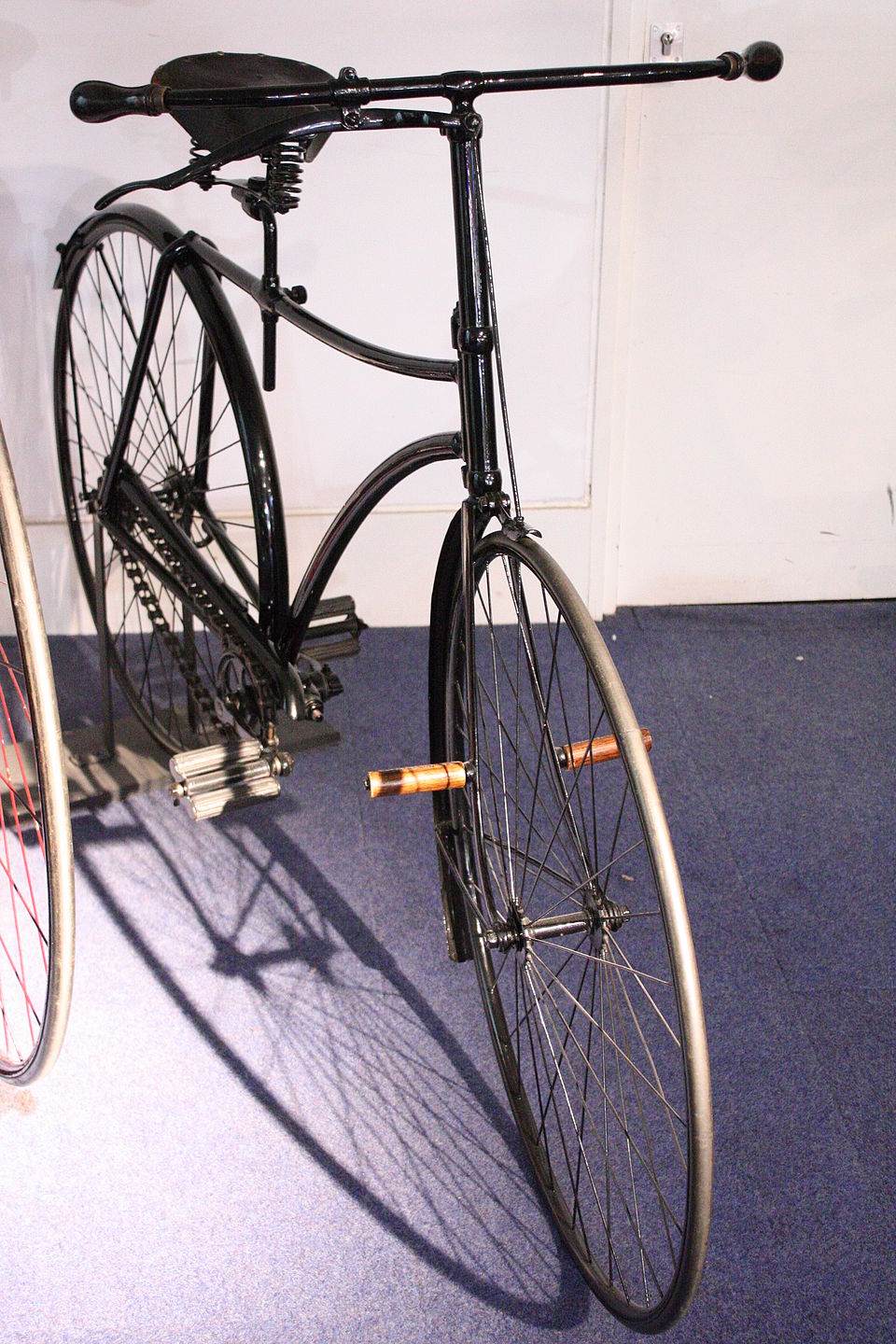
chain drive and rear-wheel propulsion. This move, pioneered by designers like John Kemp Starley with his "Safety Bicycle" in 1885, decoupled the pedals from the driven wheel. Instead of directly turning the front wheel, pedals now powered a chain that, in turn, drove the rear wheel. This not only improved efficiency but, crucially, allowed for equal-sized wheels, a radical departure from the unstable "penny-farthing" (or "high-wheeler") designs that had briefly dominated. The penny-farthing, with its enormous front wheel and tiny rear wheel, was fast but notoriously dangerous, often leading to serious falls. The safety bicycle, with its lower center of gravity and more stable geometry, transformed handling, efficiency, and safety, making cycling accessible to a much wider audience.
Further refinements included:
- Metal Frames: While early frames were iron, subsequent designs evolved to lighter, stronger steel tubing, reducing overall weight and improving durability.
- Pneumatic Tires: Invented by John Boyd Dunlop in 1888, air-filled rubber tires replaced the solid rubber or iron tires, drastically improving ride comfort and grip. This innovation alone transformed the "boneshaker" into a much smoother, quieter ride.
- Improved Braking Systems: The clumsy foot-drag method evolved into more sophisticated mechanical brakes, providing reliable stopping power.
- Standardization: The late 19th century also saw a push towards standardizing wheel sizes, frame geometries, and component parts. This was crucial for mass production, repair, and ensuring compatibility, laying the groundwork for the global bicycle industry.
These cumulative improvements transformed the bicycle from a potentially dangerous novelty into a reliable, efficient, and enjoyable mode of transport. For today's riders, features like a robust chain drive, consistent wheel diameter, and responsive brakes are baseline expectations, but they were once groundbreaking innovations, each contributing significantly to the lineage of
the bicycle's true inventor: a timeline of incremental innovations.
The Enduring Legacy: Why "Who Invented The Bicycle" is a Journey
The captivating journey from Karl Drais's Laufmaschine to the boneshaker, and ultimately to the modern bicycle, underscores a fundamental truth: great inventions are rarely the product of a single mind or moment. Instead, they are often the culmination of iterative improvements, visionary leaps, and the collaborative spirit of inventors across generations.
The Laufmaschine introduced the indispensable concept of steerable balance on two wheels. The Michaux workshop added the revolutionary element of pedal propulsion. Subsequent innovators refined the drivetrain, enhanced safety with equal-sized wheels and chain drives, and improved comfort with pneumatic tires. Each contribution was a vital stepping stone, building upon the last and addressing new challenges as the design evolved.
Understanding this rich history offers a deeper appreciation for today's bicycles. The lightweight frames, precision gears, advanced braking systems, and ergonomic designs are all descendants of those foundational ideas. They stand on the shoulders of Drais, Michaux, Starley, and countless other engineers and artisans who dedicated themselves to perfecting personal mobility. So, while Karl Drais ignited the spark, and Pierre Michaux fanned the flames with pedals, the answer to
who invented the bicycle is best understood as a resounding chorus of innovators, each adding a crucial note to its pedal-powered evolution.
The bicycle's journey from a rudimentary wooden glider to a sophisticated machine highlights humanity's continuous quest for efficiency, freedom, and joy in motion. It's a legacy that continues to inspire, proving that even the most seemingly simple inventions have a complex, fascinating past.